
Program Mission
The Vascular Technology bachelor's degree completion program enables registered professionals in vascular technology to further their knowledge and skills necessary for career advancement, to become effective communicators, problem solvers, critical thinkers, responsible managers and leaders, and to value lifelong learning.
Program Educational Objectives
The program prepares students to:
- Utilize diagnostic techniques, sound judgment and good decision making to provide patient services.
- Be leaders in the field of vascular technology who contribute to the field on a local, regional or national level.
- Think critically, communicate effectively and exemplify professional ethics.
- Become lifelong learners and responsible citizens.
Program Student Learning Outcomes
- The student will demonstrate the ability to communicate effectively in oral, written and visual forms.
- The student will demonstrate the ability to work effectively in teams.
- The student will demonstrate an ability to provide basic patient care and comfort.
- The student will employ professional judgment and discretion.
- The student will demonstrate knowledge and understanding of human gross anatomy, sectional anatomy, and normal and abnormal vascular anatomy.
- The student will demonstrate knowledge and understanding of vascular physiology, pathology, and pathophysiology.
- The student will demonstrate knowledge and understanding of vascular physical principles and instrumentation.
- The student will demonstrate knowledge and understanding of clinical vascular diagnostic procedures and testing.
- The student will demonstrate an understanding of diverse cultural and humanistic traditions in the global society.
- The student will be able to perform scholarly research and to contribute that knowledge to the field of vascular technology.
Summary of Program Student Learning Outcomes
The Medical Imaging Technology faculty formally assess the student learning outcomes summarized in the annual program assessment report. Additional details can be found in department assessment records.
Program Curriculum Map
The curriculum map for the Vascular Technology Degree Completion program can be found on the catalog web page on the Oregon Tech website, www.oit.edu/catalog.
Annual Program Assessment Reports
Contact
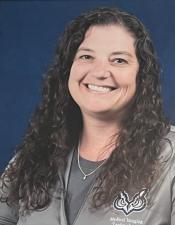
Leah was delighted to join the faculty at Oregon Tech in 2014. She has a passion for teaching and loves watching her students grow in their knowledge, skills, and confidence during their time on campus. Leah was the 2024-25 Oregon Tech Foundation Excellence in Teaching award winner for the College of Health, Arts, and Sciences.
As an alumna of Oregon Tech, Leah has earned a Bachelor of Science in Vascular Technology ('03) as well as a Master of Science in Allied Health (now Healthcare Leadership) ('18). She fulfilled her clinical externship requirement in the Bronx, New York at Montefiore Medical Center, and began her imaging career in the San Francisco Bay Area. Working with Mint Medical, she functioned as a staff sonographer, then technical director of the vascular laboratory at Kaiser Permanente Santa Clara for 11 years. Leah also volunteers in the ultrasound community in various capacities, including on the Board of Directors of Inteleos and as a liaison between the Society for Vascular Ultrasound and the Joint Review Committee on Education in Cardiovascular Technology. She continues to consult in the field as an invited speaker and provides workshops for practicing sonographers and physicians across the world.
Outside of the classroom, Leah enjoys keeping up with her two children, traveling, and doing just about anything outdoors. Fun fact: Leah was an athletic and academic All-American softball player for the Hustlin' Owls in her undergrad years, and has been inducted into the Howard Morris Athletic Hall of Fame at Oregon Tech!!
Boivin Hall