
The Oregon Tech Board of Trustees approved proceeding with a Bachelor of Science in Artificial Intelligence degree during its December meeting, wit
Artificial Intelligence Program
Oregon's first applied Bachelor of Science in Artificial Intelligence is welcoming its first cohort of students in Fall 2026. It is a polytechnic, hands-on program preparing students to build, deploy, and manage AI systems from Day 1.
What Artificial Intelligence offers
What “Polytechnic” Means in AI
What “Polytechnic” Means in the Artificial Intelligence Program
In the Bachelor of Science in Artificial Intelligence, polytechnic means learning artificial intelligence by building and applying systems that address human and organizational needs.
Polytechnic learning in artificial intelligence includes:
- Coursework focused on real use cases
- Labs and capstone projects using production tools
- Faculty-led projects with external partners
- Training in deployment, monitoring, and system integration
Students gain experience working across disciplines, preparing them to operate within teams that include engineers, analysts, managers, and domain specialists.
The departmental faculty advise students. View the list of academic advisors.
If a student is unsure who their assigned academic advisor is, please contact the department chairperson or the Academic Advising office below.
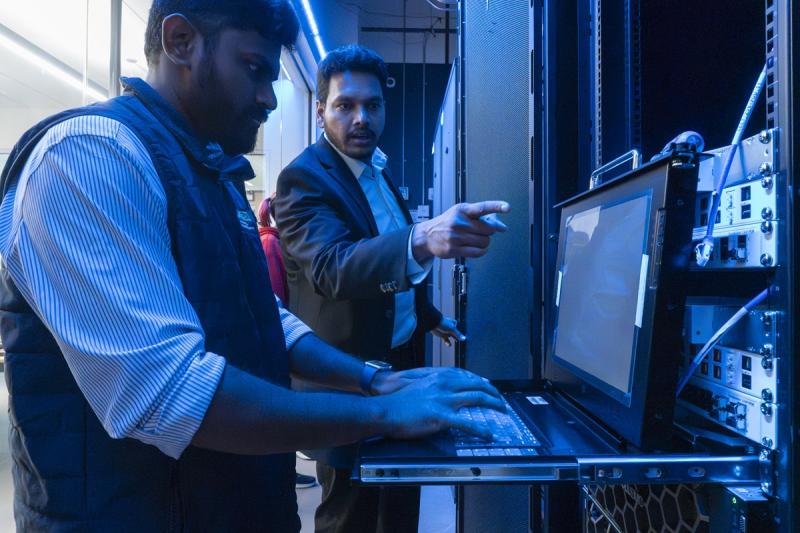
- Applied Computing Lab & Applied Computing Learning Lab - Dedicated spaces where students work with real tools, datasets, and AI/ML systems
- Oregon Tech Cybersecurity Community Clinic (OTC³) - Oregon's first member of the national Consortium of Cybersecurity Clinics (UC Berkeley/MIT, supported by Google). OTC³ is AI-infused, giving students the opportunity to apply AI techniques to real cybersecurity assessments for local businesses and organizations
- High-Performance Computing (HPC) - Oregon Tech is expanding into HPC infrastructure for modern AI workloads, large-scale data processing, and model training
- NAIRR Sandboxes Pilot Access - Faculty are participating in the National AI Research Resource (NAIRR) Pilot, an NSF-supported initiative providing access to national-scale AI computing, data, and training resources. Students benefit from exposure to deep learning sandboxes and cloud-scale AI infrastructure
Oregon Tech Students Shine on the National Stage
Oregon Tech students earned six awards at the Americas Innovate IT Collegiate Conference (AITCC) 2026, a national competition that brings together top student talent and industry leaders to explore emerging technologies, foster collaboration, and inspire innovation.
Award Highlights
- 1st Place – Analyze IT Challenge: Aiden Kimberling & Uriel Aguilar Torres
- 3rd Place – Analyze IT Challenge: Cole Bentley & Dominik Kuller
- Honorable Mention (2 teams) – Cyber Sentinel CTF: Both Oregon Tech teams ranked Top 10 of 20
- Honorable Mention – Troubleshoot IT Challenge: Cole Bentley (ranked No. 4 in the finals)
Faculty mentors: Dr. Praveen Kumar Guraja and Mr. Manish Nalluri
The AI Club at Oregon Tech connects students passionate about artificial intelligence, machine learning, and emerging technologies through hands-on projects, national competitions, guest speakers, and peer collaboration. Open to all majors.
- Faculty Advisor: Dr. Praveen Kumar Guraja
- Assistant Advisor: Mr. Manish Nalluri
Jobs and Careers in Artificial Intelligence
Artificial intelligence professionals work with data, software, and systems to automate processes, support decisions, and enable new capabilities. Roles span technology, manufacturing, healthcare, transportation, energy, and public service.
Graduates of Oregon Tech’s Artificial Intelligence program are prepared for roles such as:
- Artificial intelligence engineer
- Machine learning engineer
- Data analyst
- Systems integration specialist
- Automation engineer
The curriculum supports career readiness through portfolio development, team projects, and engagement with employers hiring for artificial intelligence roles. Industry partnerships, including collaborations with cloud and hardware providers, support student learning and workforce alignment.
Costs
For differential rates of Oregon Tech special programs, majors, and mandatory fees.
Please visit our Tuition and Fees Page.
Financial Aid & Scholarships
Scholarships are available for students from all walks of life—first-time college students, career changers, and everyone in between. Take the first step toward an affordable, high-quality education and let us help you build the skills you need for a brighter tomorrow.
Featured Courses
Oregon Tech’s Artificial Intelligence program provides learning by doing, not just working from a textbook. Students get hands‑on practice with the necessary tools and projects that offer a clear understanding of how AI works in the real world. Throughout the course, students will gain skills in important AI topics, including large language models, machine learning, data-driven logic, and AI-controlled computer systems. By working on straightforward, practical skills, students learn how AI can assist in solving problems in many fields of study and can prepare for future careers in technology.
- AI 101: AI for Everyone - Accessible AI introduction from Day 1
- AI 205: Applied AI Fundamentals - Hands-on AI tools starting freshman year
- AI 305: Natural Language Processing - Building systems that understand human language
- AI 405: Computer Vision - Teaching machines to interpret visual data
- BUS 327: AI Prototyping & Entrepreneurship - Where AI meets real product development
- PHIL 355: Ethics & Philosophy for AI - Ethical and societal dimensions of AI
- AI 491/492: Capstone I & II - Two-part applied senior capstone with industry/community partners
The hands-on courses at Oregon Tech help prepare students for a career in Artificial Intelligence.
Design
Design and evaluate artificial intelligence models
Communication Skills
Communicate technical results to varied audiences
AI Ethics and Law
Address ethical, legal, and social considerations
Operational Settings
Deploy artificial intelligence systems in operational settings
Team Contribution
Contribute to teams using artificial intelligence in practice
Assistant Professor
Engineering, Technology & Mana
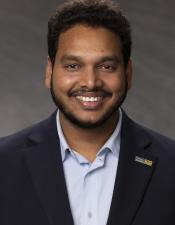
Dr. Praveen Kumar Guraja is a Tenure-Track Assistant Professor of Cybersecurity and Information Technology in the Department of Applied Computing & Geomatics at the Oregon Institute of Technology (Oregon Tech). He develops and teaches courses in cybersecurity, IT, and artificial intelligence, and contributes to Oregon Tech’s forward-looking Bachelor of Science in Artificial Intelligence program. He also serves as faculty advisor for the TechSec Club, mentoring students in research, competitions, and the Applied Computing Learning Lab.
Before joining Oregon Tech, Dr. Guraja served as Division Chair, Founding Program Coordinator, and Assistant Professor of Information Technology Management at the University of Pikeville (UPIKE), where he launched undergraduate and graduate ITM programs integrating industry micro-credentials with experiential learning. His leadership helped UPIKE’s IT Club earn multiple national awards from the USITCC.
Dr. Guraja’s research focuses on the intersection of AI, cybersecurity, and data analytics, exploring how AI-driven systems enhance decision-making, strengthen security, and promote inclusion in underrepresented communities. He has published in peer-reviewed journals, presented at national and international conferences, and collaborated on NSF and NIH-funded projects.
His academic leadership encompasses grant writing, curriculum design, and student mentorship, securing over $50,000 in research and experiential learning funding for students. Dr. Guraja has received numerous honors, including the 2025 Excellence in Research Award, the 2022 Provost Award for Faculty Excellence and Leadership, the 2024 ACA Faculty Fellowship, and induction into Epsilon Pi Tau, the international honor society for professionals in technology.
A first-generation college graduate, Dr. Guraja actively serves on professional committees and advisory boards with organizations such as AAAI, IEEE, ACM, ATMAE, ASEE, and ISSA, inspiring the next generation of innovators in cybersecurity, IT, and AI.
Dr. Guraja also brings over a decade of industry experience in IT operations and enterprise systems, having served in technical and leadership roles at Pittsburg State University, Automatic Data Processing (ADP), Unisys India Pvt. Ltd., and Genpact India Pvt. Ltd. His professional background in systems administration, database management, and enterprise IT services informs his teaching and applied research.
Visiting Instructor
Applied Computing & Geomatics
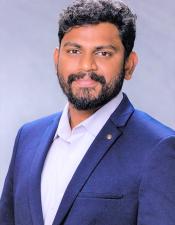
Manish Nalluri brings over six years of combined experience across industry and academia, focusing on application security, identity and access management, penetration testing, and enterprise IT infrastructure. Before joining Oregon Tech, he served as an IT Assistant and also as a Teaching Assistant at George Mason University, where he managed IT systems, supported cybersecurity risk assessment, and mentored students on research and security projects. He also worked with Fortune 500 companies as an Application Security Engineer and as a Cybersecurity Analyst, specializing in security audits, vulnerability assessments, and incident response.
Manish earned a master’s degree in Information Security and Assurance from George Mason University, where he concentrated in Applied Cybersecurity. He also holds a bachelor’s degree in Computer Science and Engineering from Jawaharlal Nehru Technological University in India. His academic work includes research on cloud security breaches, zero-day vulnerabilities, and national cybersecurity policies, as well as projects on anomaly detection and secure mobile applications.
He is a Certified Ethical Hacker (CEH), EC-Council Certified Security Analyst (ECSA), Certified SOC Analyst, AWS Solution Architect, CompTIA Security+ certified, and holds other industry credentials. His professional interests include penetration testing, access management, cloud security, and emerging cybersecurity threats.
AI Resources
Additional Resources
Related Programs