

Program Mission
The Natural Resources Master's Program (MSNR) at Oregon Tech prepares students to apply techniques of scientific research to real-world biological problems encountered in business, industry, government, and education.
Our world, locally and globally, faces unprecedented environmental challenges. In the Klamath Basin we are faced with managing millions of acres of private, state, and federal lands to reduce catastrophic wildfire risk, improve water quality, maintain biodiversity, and produce valuable natural resources. Furthermore, many federal and state natural resource agencies have an aging workforce that is retiring, leading to significant vacancies at many agencies. This program aims to address these challenges.
Program Student Learning Outcomes
- PSLO 1 : Graduate students will demonstrate conceptual and applied knowledge of the ecology, conservation, and management of natural resources through the completion of an original, empirical thesis.
- PSLO 2: Graduate students will generate viable questions, pose reasonable hypotheses, and design a robust observational or experimental study within their field of expertise.
- PSLO 3: Graduate students will analyze data using current and relevant methodologies and effectively communicate their results with appropriate data visualizations.
- PSLO 4: Graduate students will demonstrate professional level oral and written scientific communication skills through their thesis defense and project manuscript.
- PSLO 5: Graduate students will effectively synthesize and critique scientific work and writing.
MSNR Program Curriculum
This map shows required courses for the degree and *recommended* terms to take each course (the term sequence is subject to change) | ||
| 1st Year - Fall | Credits | |
| BIO 501 | Intro to Graduate Study | 3 |
| BIO 511 | Foundation in Conservation | 3 |
| Elective | 3 | |
TOTAL: | 9 | |
| ||
| 1st Year - Winter | ||
| ENV 534 | Advanced Data Analysis | 4 |
| BIO 595 | Graduate Research/Thesis | 2 |
| Elective | 3 | |
TOTAL: | 9 | |
| ||
| 1st Year - Spring | ||
| BIO 595 | Graduate Research/Thesis | 2 |
| Elective | 3 | |
| Elective | 3 | |
TOTAL: | 8 | |
| ||
| 2nd Year - Fall | ||
| BIO 512 | Current Issues | 1 |
| BIO 595 | Graduate Research/Thesis | 2 |
| BIO 537 | Advanced Data Analysis II | 4 |
TOTAL: | 7 | |
| ||
| 2nd Year - Winter |
| |
| BIO 512 | Current Issues | 1 |
| BIO 595 | Graduate Research/Thesis | 2 |
| Elective | 3 | |
TOTAL: | 6 | |
| ||
| 2nd Year - Spring | ||
| BIO 510 | Current Issues | 1 |
| BIO 595 | Graduate Research/Thesis | 2 |
| Elective | 3 | |
TOTAL: | 6 | |
| ||
DEGREE TOTAL: | 45* | |
*45 credits are the minimum requirement for the degree, but elective selection could result in higher credit totals. If you do not complete your thesis within the two-year time period, you will need to take at least one additional course per term to maintain an active student status.
List of Potential Elective Courses subject to their rotational availability. Please note that this list is not exhaustive so if you see a graduate course (5xx or 6xx) number being offered on campus which is relevant to your career trajectory, please speak to your research advisor about doing a substitution.
| Course | Credit Hours | Rotation | Term |
| BIO 526 - Evolutionary Biology | 3 | Every Year | W |
| BIO 546 - Conservation Biology | 3 | Even years | W |
| CHEM 565 – Fate & Transport of Pollutants | 4 | Every year | S |
| CE 589 - Treatment Wetlands | 3 | Odd years | S |
| ENV 521 Fire Ecology | 3 | Even Years | F |
| ENV 534 Advanced Data Analysis 1 | 4 | Every year | W |
| ENV 535 Advanced Data Analysis 2 | 4 | Every year | F |
| ENV 559 Ichthyology | 3 | S | |
| ENV 560 Risk Management and Wilderness | 3 | Odd years | W |
| ENV 566 Environmental Education | 3 | Even years | W |
| ENV 565 - Ecological Resto. & Monitoring | 4 | ||
| ENV 569 - Treatment Wetlands Credit Hours: 3 | 3 | ||
| ENV 595 - Research in Env. Sciences Credit | 4 | ||
| ENV 585 – Ecoregional Management | 3 | ||
| ENV 584 – Sustainable Human Ecology | 4 | ||
| BIO/ENV 507 – Seminars in Biology and Environmental Science | 3 or 4 | ||
| ENV 534 – Advanced Data Analysis | 3 | ||
| GIS 526 - Geospatial Vector Analysis II | 3 | ||
| GIS 532 - Customizing the GIS Environment II | 3 | ||
| GIS 546 - GIS Database Development Credit | 2 | ||
| GME 525 - Remote Sensing | 4 | ||
| PHIL 525 - Environmental Ethics Credit | 3 | Every | W |
| BIO 507 – Invertebrate Ecology | 4 | Even years | F |
| WRI 510 – Grant Proposal Writing | 3 | ||
| Other graduate level courses upon committee approval. |
Most electives are offered only one term per year and some even on a rotating 2-year basis. If there are specific electives you want to take, plan your curriculum map carefully with your research advisor to ensure you don’t miss out.
Program Curriculum Map
The curriculum map for the Natural Resources program can be found on the catalog web page on the Oregon Tech website, www.oit.edu/catalog.
Annual Program Assessment Reports
Contact
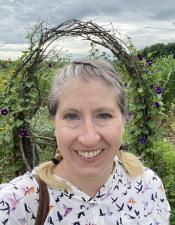
My personal and professional lives have always been centered on Outdoor Experiences. As the director of the Environmental Sciences program at Oregon Tech, I get to combine my love of nature and technical skills to promote data driven decision making in natural resource management. I have experience teaching the following courses: ENV data analysis, careers and professionalism, physical geography, intro to general chemistry, general biology, nutrition, environmental education, human anatomy, backpacking, intro to GIS, water resources, stream water chemistry, riparian assessment, and pollinator ecology. My current research is centered on pollinators. I co-advise the Beekeeping club on campus, and we use our apiary as a living laboratory for undergraduate research. In addition to honeybees, our students are conducting native pollinator surveys. Data from these ongoing studies will be used to track shifting phenological trends in response to climate change and increased forest fire activity within the Klamath Basin. When not on campus, you may find me with my family on the trail, riding my road bike, walking my two French bulldogs, playing ukulele, or paddling on the scenic waterways of southern Oregon.