
Oregon Tech offers a minor in chemistry to students interested in deepening their knowledge of chemistry, "the central science." A minor in chemistry can help prepare students for graduate school, medical school, or professional laboratory or research work. Students in fields from medicine to renewable energy to materials science will find their degrees strengthened by the hands-on experience of a chemistry minor, which includes the option for undergraduate research in chemistry.
Core Requirements:
- CHE201/204 or CHE221 - General Chemistry I (4/5 credits)
- CHE202/205 or CHE222 - General Chemistry II (4/5 credits)
- CHE203/206 or CHE223 - General Chemistry III (4/5 credits)
- CHE331 - Organic Chemistry I (4 credits)
Elective Requirements:
Students must complete 16 credit hours from the electives list below, with the following restrictions:
- At least 6 elective credits must be "above and beyond" the students' regular major – that is, they cannot be required for the major or used as technical/major electives;
- At least 8 elective credits must be CHE-prefix courses (or co-taught as CHE-prefix courses).
- At least 12 elective credits must be upper-division (300-level or higher);
Electives List:
- CHE 260 - Electrochemistry for Renewable Energy Applications (4 credits)
- CHE/PHY/ENGR 305 - Nanoscience and Nanotechnology (4 credits)
- CHE 315 - Environmental Chemistry and Toxicology (3 credits)
- CHE 332 - Organic Chemistry II (4 credits)
- CHE 333 - Organic Chemistry III (4 credits)
- CHE 441: Genetic Engineering & Therapy (1 credits)
- CHE 450 - Biochemistry I (4 credits)
- CHE 451 - Biochemistry II (4 credits)
- CHE 452 - Biochemistry III (4 credits)
- CHE 465 - Fate and Transport of Pollutants (3 credits)
- MLS 415 - Clinical Chemistry I (5 credits) *open to MLS students only
- MLS 416 - Clinical Chemistry II (5 credits) *open to MLS students only
- MLS 417 - Clinical Chemistry II (2 credits) *open to MLS students only
- EE 343 - Solid State Electronic Devices (3 credits)
- ENGR 355 - Thermodynamics (3 credits)
- MECH 360 - Engineering Materials II (3 credits)
- MET 160 - Engineering Materials I (3 credits)
- PHY 311 - Modern Physics (3 credits)
- REE 331 - Fuel Cells (3 credits)
- REE 335 - Hydrogen (3 credits)
- REE 333 - Batteries (3 credits)
- REE 337 - Materials for Renewable Energy Applications (3 credits)
- REE 346 - Biofuel and Biomass (3 credits)
- Up to 2 credits of upper division chemistry research (CHE 355, 455, and/or 495)
- Any other CHE course at the 200-level or higher, except for pharmacology courses (CHE210, CHE 350, CHE 360).
- Other special topics courses, undergraduate research, or transfer courses may also be applied towards the minor with the permission of the Natural Sciences Department.
Natural Sciences
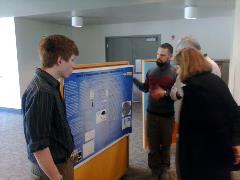
Students Adam Langenstein and Matthew Vinson present their undergraduate chemistry research project "Synthesis of silver nanoparticles and nanoclusters for use as antimicrobial agents" at the Oregon Tech project symposium in May 2014.
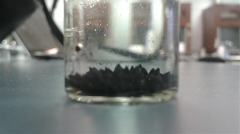
Ferrofluid produced by Danielle Nicholas in undergraduate chemistry research project "Synthesis of Ferrofluid Nanoparticles with Oleic Acid" in June 2014.
Contact
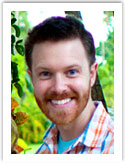
Dr. Travis Lund is the Director of the Biology-Health Sciences program in the Natural Sciences department. He spends most of his time teaching organic chemistry, genetics, the freshman Intro to Medical Sciences course, as well as an assortment of senior/grad level electives. A native of the coastal redwood forests of Crescent City, CA, he enjoys taking advantage of all four seasons in the Klamath Basin via hiking, kayaking, skiing, biking, rollerblading, spelunking, and any other outdoor activities he can entice his friends and family to partake in.
Research Background
- Asymmetric Recognition of Nucleobase Features by DNA Polymerases
- Synthesis of a Novel Dibasic (A:T) 2'-deoxyriboside
- Question Order Effects in Chemistry Concept Inventories
- Awareness and Adoption of Research-Based Instructional Practices in STEM Education
Courses Taught
- BIO 109: Intro to Medical Sciences
- BIO 235: Human Genetics
- BIO 341: Medical Genetics
- BIO 441/451: Genetic Engineering & Therapy
- BIO 495: Research Projects in Biology
- BIO 407/507: AI in Medicine
- BIO 407/507: Scientific Teaching
- BIO 509: Introduction to Biomedical Sciences
- CHE 101/104: Intro to General Chemistry (with lab)
- CHE 307: Toxicology
- CHE 407/507: Toxicology II
- CHE 331/332/333: Organic Chemistry I/II/III (with labs)
- CHE 450L: Biochemistry (labs)
Journal Articles
Undersander, M., Lund, T.J., Langdon, L.S., & Stains, M. (2017). Probing the question order effect while developing a chemistry concept inventory. Chemistry Chemistry Education Research and Practice, 18 (p. 45-54). Click here to access.
Lund, T.J., & Stains, M. (2015). The Importance of Context: An Exploration of Factors Influencing the Adoption of Student-Centered Teaching among Chemistry, Biology, and Physics Faculty. International Journal of STEM Education, 2:13. Click here to access.
Lund, T.J., Pilarz, M., Velasco, J.B., Chakraverty, D., Rosploch, K., Undersander, M., & Stains, M. (2015). The Best of Both Worlds: Building on the COPUS and RTOP observation protocols to easily and reliably measure various levels of reformed instructional practices. CBE Life Sciences Education, 14(2). Click here to access.
Lund, T.J., Cavanaugh, N., Joubert, N., Urban, M., Patro, J.N., Hoceck, M., and Kuchta, R.D. (2011). B family DNA Polymerases Asymmetrically Recognize Pyrimidines and Purines. Biochemistry, 50(33). Click here to access.
Conference Proceedings
Lund, T.J., & Owen, T. (April, 2026). Design (or remix!) a personalized course-support chatbot using a free, secure, open-source nonprofit platform. Presentation at the Instructional Technology Council AI Virtual Summit.
Lund, T.J. (November, 2025). OER (/free) AI Tools in Chemistry Education. Presentation at the American Chemical Society Western Regional Meeting, San Jose, CA.
Lund, T.J. (March, 2024). COPUS and DART in a Small Nontraditional Classroom. Presentation at the American Chemical Society National Meeting, New Orleans, LA.
Wright, K., Nguyen, A., Lund, T.J. (July 2023). Comparing COPUS and DART Data from a Small Nontraditional Classroom. Poster at the Society for the Advancement of Biology Education Research National Meeting, Twin Cities, MN.
Rahmani, S., Claybaugh, D., Stobie, J., Weitzman, K., Nguyen, C., Fang, P., and Lund, T.J. (June, 2019). Analysis of an Active Learning Classroom Utilizing COPUS and DART. Poster at the ACS Northwest Regional Meeting, Portland, OR.
Lund, T.J., Bettencourt-McCarthy, A., Anthony, S., & Bailey, S. (July, 2018). Homegrown, collaborative, faculty-led professional development. Poster at the Biennial Conference on Chemical Education, Notre Dame, IN.
Lund, T.J. (April, 2018). Using primary literature to teach content via “homemade,” inquiry-based worksheets. Presentation at the ACS Western States Chemical Education Group Conference, Eugene, OR.
Lund, T.J., Anthony, S., & Byrne, K. (June, 2017). Concept mapping as a review strategy: Effects on student achievement, attitudes, and metacognition. Presentation at the ACS Northwest Regional Meeting, Corvallis, OR.
Lund, T.J., Anthony, S., & Byrne K. (August, 2016). The effects of concept mapping on student performance, metacognitive abilities, and attitude towards chemistry. Presentation at the Biennial Conference on Chemical Education, Greeley, CO.
Anthony, S., Byrne, K., & Lund, T.J. (August, 2016). Metacognitive monitoring judgments in diverse chemistry and STEM contexts. Presentation at the Biennial Conference on Chemical Education, Greeley, CO.
Anthony, S., Lund, T.J., & VanRooyen, C. (June, 2015). Beginning a transition towards active-learning classrooms: Oregon Tech's story. Presentation at the ACS Northwest Regional Meeting, Pocatello, ID.
Stains, M., & Lund, T.J. (June, 2015). Leveraging the COPUS and RTOP observation protocols to easily and reliably measure reformed instructional practices. Poster at the Gordon Research Conference on Chemistry Education Research and Practice, Lewiston, ME.
Undersander, M., Lund, T.J., & Stains, M. (March, 2015). Probing the question-order effect on chemistry concept inventories. Poster presented at the American Chemical Society National Meeting, Denver, CO.
Lund, T.J., & Stains, M. (March, 2015). Building a Teaching Profile: Using a modified COPUS observation protocol to easily and reliably measure reformed instructional practices. Presentation at the American Chemical Society National Meeting, Denver, CO.
Lund, T.J., & Stains, M. (August, 2014). Characterization of the Research-Practice Gap in Chemistry Education and Factors Influencing It. Presentation at the Biennial Conference on Chemical Education, Allendale, MI.
Stains, M., Lund, T.J., & Pazicni, S. (August, 2014). Infusing the Science of Learning into Your Chemistry Classroom: Evidence-Based Instructional Practices. Workshop presented at the Biennial Conference on Chemical Education, Allendale, MI.
Pazicni, S., Lund, T.J., & Stains, M. (August, 2014). Infusing the Science of Learning into Your Chemistry Classroom: Cognitive Principles. Workshop presented at the Biennial Conference on Chemical Education, Allendale, MI.
Lund, T.J., & Stains, M. (August, 2014). Awareness and adoption of student-centered instructional strategies at a research-intensive institution. Presentation at the American Chemical Society National Meeting, San Francisco, CA.
Lund, T.J., Chakravety, D., Pilarz, M., Velasco, J., & Stains, M. (August, 2014). Influencing faculty instructional strategies: The effect of an on-site, semester-long faculty development workshop on classroom practices. Presentation at the American Chemical Society National Meeting, San Francisco, CA.
Lund, T.J., & Stains, M. (July, 2014). Characterization of the Biology Education Research-Practice Gap and Factors Influencing It. Invited Concluding Keynote at the Society for the Advancement of Biology Education Research National Meeting, Twin Cities, MN.