
Resumes

Resumes are crucial because they serve as your personal marketing tool, summarizing your professional journey and qualifications in a concise, easy-to-read format. A well-crafted resume tells your story by highlighting your skills, experiences, and accomplishments that align with the job you’re seeking. It provides potential employers with a snapshot of who you are, what you’ve done, and how you can contribute to their organization.

By effectively showcasing your career progression, strengths, and unique value, your resume not only demonstrates your qualifications but also communicates your professional identity and career aspirations.

Resume Formatting

Every resume is different based on the industry, accomplishments, and personal preferences of the writer. However, most resumes follow the same general format that is universal across all industries. Below you will see the different sections often included in a resume and how to present them. 

Resume Sections

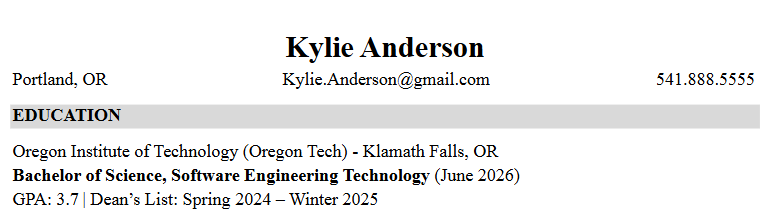
Your first and last name as well as your personal contact Information should be clearly displayed at the top of your resume, with your name in a larger font than the rest of your document (16-point font or larger). Your name should be on its own line to ensure it is easy to read and memorable for the hiring committee. Your contact information should be all together on the second line of the page, either dividing them up with a vertical line (|), or spaced out across the page as shown in the example below. For your contact information you should include at least your email and phone number. Other optional information to include on this line is your LinkedIn profile URL, your GitHub URL, or your current city and state. 

Education and contact section of resume

It is common for recent college graduates to put their education section at the top of their resume, under their name and contact information. Putting your education at the top of your resume will show recruiters that you are just finishing school which will give them some context when reviewing the rest of your resume. Your education should be included in the format highlighted below. 

When including your education, make sure to put the month and year in which you plan to graduate after the name of your degree. You can also consider adding your GPA to this section if it is a 3.0 or higher or adding terms that you were on the Dean's or President's list.  

Education section of resume

This section is optional, but common for majors that require certifications or licensure to practice such as health majors. For any certifications or licenses listed, it is important to include the full title of the certification, the governing body that awarded the license or certification, and the date issued or the date of expiration.  

Certification and licensure section of resume

The skills section is where you can set yourself apart from other graduates with the same degree by listing both your technical skills as well as your professional (or 'soft') skills. Professional skills are talents 

Skills section of resume

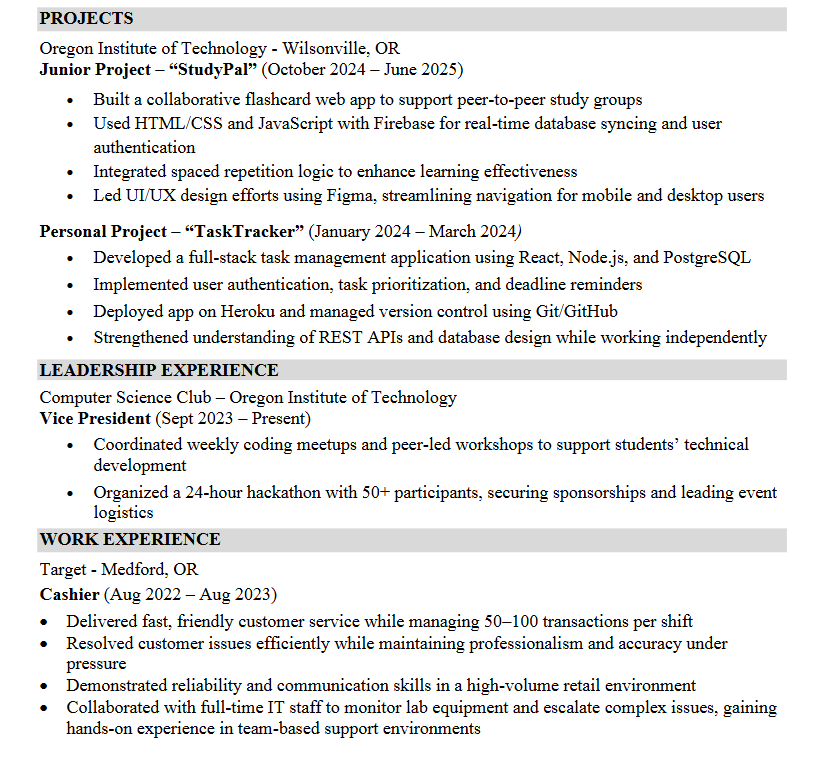
Your Experience section should be the most substantial part of your resume and where you invest the most time refining. It should showcase the experiences most relevant to the positions you’re pursuing and clearly demonstrate how you applied your skills in real-world settings. 

If you have several different experiences you would like to share in this section that don't align with one another, consider cutting your Experience section into multiple sections such as: Professional Experience, Project Experience, Volunteer Experience, Leadership Experience, Additional Work Experience, etc.  

Experience section of resume

A few other common sections you may see in a resume are: 

  • Awards - where you would include any awards or scholarships given to you. 

  • Professional Memberships - here you would include if you were a member of any professional organizations or associations related to your field of study or career path. 

  • Leadership - in this section you would list any leadership positions or roles you held and your responsibilities. This would include being a captain of a sports team, an executive member of an on-campus organization, being a teacher's assistant or tutor for a class, etc.  

💪 Power Statements: How to Make the Most of Your Resume Bullet Points 

Power statements are strong, specific bullet points on your resume that describe what you did, how you did it, and what you accomplished. Instead of just listing tasks, power statements show your impact and help employers understand the value you bring. 


Power statement format

💡 Tips for Writing Power Statements: 

  • Start each bullet with a strong action verb (e.g., led, created, collaborated, analyzed) 

  • Use numbers or outcomes when possible (even estimates!) 

  • Tailor each statement to the job or program you're applying for 

  • Think about skills you developed, not just tasks you completed 

Power Statement Examples

  • Collaborated with a team of 5 nurses in a high-acuity unit to respond to emergency codes, resulting in faster patient stabilization times.

  • Educated patients and families about post-discharge care, improving satisfaction scores during clinical evaluations. 

  • Administered medications and documented responses in alignment with safety protocols, reducing charting errors during shifts. 

  • Performed abdominal and OB/GYN ultrasounds by following clinical protocols, assisting in early diagnosis and timely treatment planning.

  • Communicated clearly with patients during procedures to reduce anxiety and improve patient cooperation. 

  • Maintained equipment and ensured accurate image quality through routine quality checks, preventing scan delays. 

  • Conducted field surveys using AutoCAD and GPS equipment to collect accurate site data for roadway design projects. 

  • Designed a stormwater drainage system by analyzing hydrology models, helping reduce projected runoff by 30%. 

  • Collaborated with cross-functional teams to monitor project timelines, contributing to an on-time bridge rehabilitation project. 

  • Developed a full-stack web application using React and Node.js by collaborating with a team of 4, resulting in a fully deployed MVP.

  • Debugged and optimized existing codebase, reducing application load time by 45%.

  • Participated in Agile sprints and daily stand-ups, improving team communication and delivery speed. 

  • Integrated APIs and conducted unit testing using Jest, enhancing product reliability and minimizing post-release bugs. 

  • Designed and tested PCB layouts using Altium Designer, leading to successful prototyping for a low-voltage power supply project. 

  • Programmed microcontrollers in C for automation of sensor systems, improving data accuracy in lab simulations. 

  • Wired, tested, and troubleshot electrical circuits for a renewable energy project, improving system performance and contributing to a 10% increase in energy efficiency. 

  • Conducted simulations using MATLAB and Simulink to predict circuit behavior, improving design reliability. 

Cover Letters


What's the purpose of a cover letter?

  1. To introduce yourself to the employer, clarify which role you are interested in, highlight your relevant skills and experiences, and explain why you are the best fit for the position. 

  1. To highlight your skills and qualifications for the position. This shouldn't be a repeat of your resume, but a place to elaborate on how your past work experiences will translate positively to the job you're applying for. 

  1. To encourage the next step in the application process: e.g. "I look forward to having the opportunity to meet and discuss my qualifications in detail," "I can be reached at (541) 555- 0000." 

  1. Explain any possible red flags. Your cover letter is the best place to explain anything the hiring team may be wondering about such as gaps in employment, applying to jobs out of state, or changing career fields. 

Why are cover letters important?

A cover letter is your chance to go beyond the resume and show why you’re the perfect fit for a specific job. By customizing your letter with keywords from the job posting, you demonstrate your enthusiasm, highlight relevant skills, and show that you’ve done your homework on the organization. It’s your opportunity to stand out from other candidates with similar qualifications. 

Do recruiters read cover letters?

Only if they’re compelling. A generic cover letter won’t make an impact, but a thoughtful, enthusiastic letter can be the deciding factor in getting you an interview, especially when candidates are equally qualified.

Cover letters: Structure and Formatting

Cover letters should be one page in length, containing 4-5 paragraphs explaining your qualifications, experience, and what you would bring to the company as an employee. 

In this section, you will start by telling the search committee who you are, how you learned about the position, and how your past skills and experiences prepare you to thrive in this role. Make sure to specifically mention which role you are applying for, as many companies will have multiple positions open at one time. If you have networked with or have a personal contact at the company, this would be the place to mention it. Follow that with a sentence about how your past experiences have made you a great candidate for this role. 

In the body of your cover letter, focus on highlighting the skills, qualifications, and achievements that directly align with the position's job description. Carefully review the posting to identify the key qualifications and responsibilities the employer is seeking. Then, demonstrate how your background makes you a strong match. If the role mentions specific tasks, procedures, or technologies you’ve used before, include a paragraph describing your hands-on experience with those duties and the impact of your work. Use concrete examples to show how you’ve successfully applied your skills in previous roles. 

The goal of your final paragraph is to thank them for reviewing your application and encourage them to reach out for an interview. Be sure to actively convey your interest and strong desire for an interview. Remember, the primary purpose of the resume and cover letter is to obtain an interview, not to get you a job. 

Curriculum Vitae

A curriculum vitae (CV) is a detailed document that outlines your academic and professional achievements, including education, research, publications, and work experience. It’s often required when applying for academic, research, or specialized positions, especially in higher education or science fields and for applying to graduate school.

Tips

  • Tailor your CV to the program you're applying to by emphasizing experiences related to the field.
  • List experiences in reverse chronological order.
  • Use clear headings and consistent formatting.
  • Unlike a résumé, a graduate school CV can be more than one page if you have substantial academic or research experience.

Curriculum Vitae (CV) Sections

  • Name 
  • Email
  • Phone Number
  • LinkedIn (optional) 
  • Institution(s)
  • Degree(s)
  • Graduation date (or expected graduation) 
  • GPA (if strong and relevant) 
  • Honors
  • Research projects 
  • Lab experience 
  • Independent studies 
  • Positions relevant to your field 
  • Teaching or tutoring experience, if applicable 
  • Journal articles 
  • Conference presentations 
  • Posters
  • Awards given related to field of study 
  • Scholarships for research 
  • Student organizations
  • Volunteer work 
  • Professional organizations 
  • Laboratory techniques
  • Programming languages 
  • Statistical software 
  • Languages 

Additional Assistance

All Oregon Tech students have access to Handshake Sidekick. Sidekick is an AI-powered resume helper you can use when you are logged into Handshake. With Sidekick, you can:

  1. Upload an existing resume or start from a resume already stored in your Documents
  2. Chat with an AI assistant to get suggestions for improved wording, structure, and how to highlight your skills
  3. Ask for edits focused on a particular job or type of role

To get started: Click on "Optimize resume" at the top of the Jobs page. For more assistance with getting started, please watch this video or refer to this article

Additionally, use our Helpful Documents on the right as you create your resume and cover letters. We are also here to help, make an appointment with a career advisor on Handshake.