
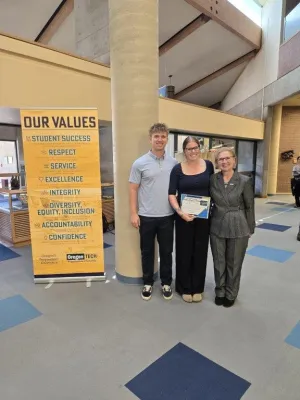
Kuenzi, Carley Rogers, Dean Alp
Oregon Tech has announced the undergraduate winners of its 2026 IDEAfest, a university-wide showcase of research, innovation, and creativity. The winning Klamath Falls student projects included a microfluidic platform to study multiple myeloma, a multiplayer video game, and the development of soft robotic artificial muscles using HASEL actuators.
IDEAfest is an annual event where students present posters and demonstrations of their junior, senior, or capstone projects. Oregon Tech students are known for creating interesting, innovative projects.
“The projects presented at IDEAfest reflect the creativity, perseverance, and technical excellence of our students,” said Dr. Neslihan Alp, Dean of the College of Engineering, Technology, and Management. “Seeing them tackle complex challenges and develop solutions with real-world impact is one of the most rewarding aspects of our mission as a polytechnic university.”
The top honors for Best Presentation were awarded to two projects. Biology-Health Sciences students Carley Rogers and Zach Kuenzi earned co-first place for their research on a microfluidic platform to study multiple myeloma, the second-most diagnosed hematological cancer worldwide. The project uses a 3D-printed “endothelium-on-a-chip” model to replicate the bone marrow environment and study how cancer cells respond to fluid flow and chemical signals such as stromal cell-derived factor-1 (SDF-1).
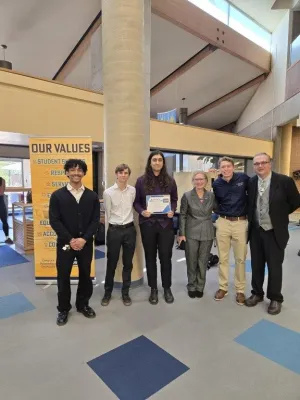
Chinander, Dean Alp, Parker, Fagen, Theo Gwynn
Software Engineering Technology students Christian Grende, Theodore Gwynn, Kayleb Cook, Parker Fagen, and dual Data Science and Software Engineering Technology student Ethan Chinander also earned co-first place for Depths, a cooperative multiplayer video game where players explore procedurally generated caves and work together to collect items and escape hazards.
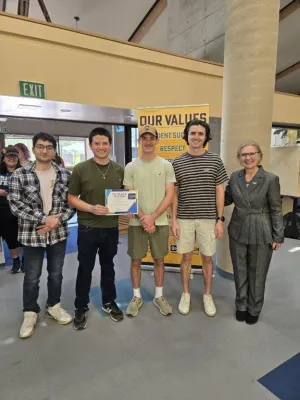
Amador-Gonzalez, Thomas Moore, Jacob Maier,
Dean Alp
The first-place award for Best Poster was presented to the team of Electrical Engineering students Anesti Audeh, Dana Glasser, Thomas Moore, Jacob Maier, and Mechanical Engineering students Erick Amador-Gonzalez and Jacob Bruner for their project on soft robotic artificial muscles using HASEL (Hydraulically Amplified Self-healing Electrostatic) actuators. In addition to actuator design, the team is developing an integrated control and monitoring platform. This system enables real-time control of multiple high-voltage converters and actuators while simultaneously visualizing voltage behavior, system performance, and sensor data.
Additional awards presented include:
- Second Place Poster – OIT Cybersecurity Community Clinic Website and Dashboard Development by Cybersecurity students Ryan Reynolds, Josh Fischer, and Aiden Kimberling.
- Third Place Poster – Embedding Breast Cancer Cells in 3D Anti-Inflammatory Environments by Biology-Health Sciences students Tori Leyba, Allison Hammer, Michelle Bonilla, Heather Ritter, and Ethan Roeloffs.
- Third Place Presentation – Macroinvertebrates as Bioindicators in the Deschutes River near Sun River, Oregon, by Environmental Sciences students Hannah Wiles, Duncan Rothe, Kali Rowe, and Rosa Riger.
The Faculty & Staff awards include:
- Oral Presentations:
ETM: Shawn Duan (MMET): Study on Good and Bad Whole-Body Vibrations via Multibody Dynamic Approaches
HAS: Darlene Swigart (Dental) & Andrea McCracken (COM): Integrating Social Determinants of Health Screening in Student Dental Hygiene Clinical Practice - Poster Presentations:
Dawn Bailey (HSS): Training Graduate Students & Behavior Technicians to Become PECSperts
Ashton Greer, Jintai Wang, & CJ Riley (Civil): Lower-Carbon Concrete with the Use of Mt. Mazama Volcanic Ash
Caroline Doty, Laurie Sprauer, & Rachelle Barrett (MLS): Transgender Health Education Within MLS/MLT Programs in the US: A Pilot Study - FORGE:
ETM: Keerthi Andukuri (MGMT): Beyond the Grade: Cognitive Profiling in Higher Education
HAS: Amanda Chastain (HSS): Starting Small to Solve Social Problems: Evaluating the Effects of Social Feedback and Social Categorization on Resource Allocation
IDEAfest 2026 was made possible through the support of South-Central Oregon Regional Innovation Hub, Cypress Creek Renewables, and Darrel and Diana Samuels.
The university extends its appreciation to all who participated, supported student work, and contributed to the success of this year’s event. Their involvement continues to strengthen IDEAfest as a meaningful platform for showcasing student achievement and innovation.
For a full list of IDEAfest projects, visit www.oit.edu/ideafest.