
Explore Biological Sciences
Explore the full spectrum of biological sciences while preparing for some of the most demanding and rewarding careers in medicine and health. Our biology programs give students a deep understanding of life from molecules to ecosystems, along with the critical thinking and scientific skills needed for advanced study.
Our graduates build strong foundations in areas such as anatomy, physiology, genetics, microbiology, and ecology, and they consistently earn acceptance into professional programs including medical school, dentistry, pharmacy, physician assistant studies, and other health-related fields.
Bachelor of Science in Biology - Health Sciences
This degree program provides an intensive course of study in the basic sciences, social sciences, communication, and mathematics to prepare students for entry into professional programs. Our science classes include hands-on labs with professors, a strong emphasis on medical application, and critical thinking about case studies and relevant biomedical research.
The program meets or exceeds the prerequisite requirements for Professional graduate schools of:
- Medicine (Pre-Med)
- Osteopathic medicine (Pre-Med)
- Dentistry (Pre-Dental)
- Veterinary medicine
- Optometry
- Pharmacy
- Physical Therapy
- Occupational Therapy
- Podiatry
- Physician Assistant
All Pre-Professional Pathways and Resources
Courses in health management, medicine microbiology, biochemistry, and molecular and cell biology also provide preparation for careers in biotechnology or graduate work in public health, medical administration, or science PhD programs.
Highlighted Pathways
We offer an exceptional pathway for students interested in veterinary careers. We are fortunate to have faculty who maintain strong relationships with veterinarians across the region. These partnerships allow us to create high-quality internships and shadowing opportunities that give students real-world experience working with companion animals, livestock, wildlife, and clinical care settings.
In addition, we offer specialized veterinary preparation courses designed to strengthen student readiness for competitive veterinary programs. These courses cover topics such as animal physiology, health and disease, genetics, animal behavior, and professional skills needed in veterinary practice. Students also receive guidance on meeting veterinary school prerequisites, building strong applications, and navigating the admissions process.
Our goal is to provide every student with the academic background, practical experience, and mentorship needed to confidently pursue veterinary school or other animal-focused careers.
Signature Classes:
- Intro to Vet Science
- Biology of Companion Animals
- Intro to Wildlife Rehabilitation
- Comparative Anatomy
- Parasitology
- Developmental Biology
- Evolutionary Biology
Our program offers an exceptional pathway for students interested in careers in exercise physiology, human performance, rehabilitation, and wellness. Students gain a strong scientific foundation in how the body responds to physical activity, training, and clinical conditions, while building practical skills that translate directly into professional settings.
Our faculty have deep connections with regional hospitals, physical therapy clinics, sports performance centers, strength and conditioning programs, and public health organizations. These partnerships allow us to create high-quality internships and shadowing experiences that give students real-world insight into patient care, fitness assessment, athletic performance, and rehabilitative exercise.
Students take specialized coursework in areas such as exercise testing and prescription, kinesiology, biomechanics, sport physiology, clinical exercise interventions, and chronic disease management. These courses are designed to prepare students for nationally recognized certifications and to help them stand out as competitive applicants for graduate programs in physical therapy, athletic training, exercise physiology, occupational therapy, and other health-related fields.
Our goal is to help students develop the scientific knowledge, hands-on experience, and professional readiness needed to build impactful careers in human health, performance, and rehabilitation. We prepare students not only to succeed academically, but to thrive as compassionate, skilled, and adaptable professionals in a growing field.
Signature Classes:
- Exercise Physiology
- Strength & Conditioning
- Biomechanics
- BIO 467 Biomedical Device
Our Pre-Pharmacy track provides students with a clear and efficient route to becoming a licensed pharmacist through a streamlined three-plus-three partnership with Pacific University. Students spend their first three years at Oregon Tech completing foundational coursework in biology, chemistry, physiology, and mathematics while gaining hands-on experience in laboratory and clinical preparation. During this time, faculty advisors work closely with students to ensure they are meeting all prerequisite requirements and building strong, competitive applications.
After completing three years at Oregon Tech, qualified students transition directly into Pacific University’s three-year Doctor of Pharmacy program. This accelerated structure allows students to complete both their pre-professional studies and their professional doctorate in a total of six years rather than the traditional seven or eight, saving both time and tuition while maintaining a rigorous, high-quality education.
Students benefit from small class sizes, dedicated faculty mentors, strong support in preparing for pharmacy school interviews, and opportunities to explore pharmacy careers through job shadowing and community health activities. Our curriculum provides a strong scientific foundation in organic chemistry, microbiology, biochemistry, pharmacology, and human physiology, ensuring students are fully prepared for the demands of professional training.
Whether students are interested in clinical pharmacy, hospital practice, community pharmacies, drug development, or public health, our program is designed to help them build the academic skills, real-world experience, and professional confidence needed to thrive in the pharmacy field.
Signature Classes:
- Medical Genetics
- Immunology
- Comparative Virology
- Cell Biology
- Pathophysiology II
- Clinical Pharmacology
There are several faculty advisors in our program, and we encourage students to work closely with the advisor they connect best with. The Biology–Health Sciences program also urges students to begin volunteering in medical settings, possibly during high school and especially during college. Our Health Sciences student club helps students get connected with volunteering and shadowing opportunities, often at the hospital located just across the street from Oregon Tech, or at nearby medical offices
Oregon Tech also offers a master's degree in Biomedical Sciences. A 3+2 program is available for students to earn a bachelor's and master's degree in five years.
Careers
With 100% of Oregon Tech Biology-Health Sciences graduates either employed or seeking an advanced degree within six months of graduation, our graduates who apply to graduate programs are often accepted. Our alumni in graduate school often report that they are better prepared than their peers from other universities, and they often become leaders within their graduate programs and are highly successful in their professional careers.
Average annual salary** for medical professions our graduates work in after receiving advanced degrees:
**U.S. Bureau of Labor Statistics, May 2024
Some paths other than grad school include:
- Clinical or research lab tech
- Phlebotomist
- Clinical Lab Science
Core curriculum includes:
- Full-year freshman/sophomore classes with labs in General Chemistry, Principles of Biology and General Physics that are foundations for everything else, and required for most graduate programs.
- Math including calculus and statistics to increase your quantitative skills.
- Classes in communication and humanities to complement your scientific education.
- Classes in social sciences including medical sociology and psychology that are increasingly needed to understand healthcare needs today.
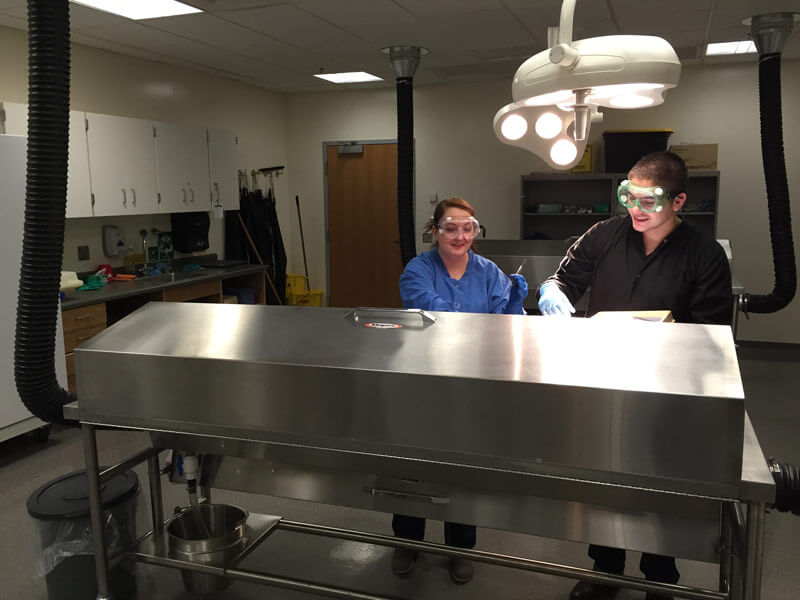
- Full-year, upper-division classes in Advanced Anatomy & Physiology, including hands-on cadaver dissection, and in Pathophysiology to learn how the human body can fall out of normal.
- Medical Microbiology where you will learn about microorganisms, explore how pervasive they are in our environment, and test different infection-control measures.
- Full-year, upper-division classes in Organic Chemistry and in Biochemistry that focus on medical applications and include inquiry-driven labs where students design some of their own experiments.
Our students also choose among classes in medical terminology, nutrition, medical genetics, neuroscience, developmental biology, cell biology, clinical pharmacology, nanoscience, parasitology, kinesiology, immunology, epidemiology and others. While the curriculum is very challenging, admission into medical schools is highly competitive and requires excellent academic achievement. These courses feed student interests as well as helping them become strong applicants for the graduate school programs of their choosing.